Teachers, athletic coaches, and childcare providers are often the first adults to notice when a child is choking, struggling to breathe, injured, or suddenly unresponsive. Emergency medical teams bring advanced care, but the actions taken during the first few minutes can make a major difference.
That is why completing a CPR and First-aid Certification Course is more than an employment requirement. It prepares school and childcare professionals to respond calmly while another staff member calls 911, retrieves an AED, or guides emergency responders to the scene.
For educators and caregivers in San Jose, local training also makes certification easier to fit around school hours, practices, weekend tournaments, and childcare schedules. Safety Training Seminars offers CPR, BLS, ACLS, PALS, NRP, and First Aid course options through its San Jose training center at 1261 Lincoln Ave, Ste 213, San Jose, CA 95125. The center is located in Willow Glen and can be reached from Lincoln Avenue, Willow Street, Highway 87, and Interstate 280.
Quick Facts for San Jose Educators and Caregivers
| Feature | Details |
| Training provider | Safety Training Seminars |
| Certification organization | American Heart Association courses |
| Useful for | Teachers, coaches, childcare staff, school employees and fitness professionals |
| Skills covered | CPR, AED use, choking response and First Aid, depending on the selected course |
| Age groups practiced | Adults, children and infants in applicable courses |
| San Jose location | 1261 Lincoln Ave, Ste 213, San Jose, CA 95125 |
| Scheduling | Classes are offered seven days a week |
| Certification card | Same-day eCard is available after successful course completion |
| Parking and access | Free parking and access from several major San Jose roads |
The San Jose website lists daily training, weekend availability, extended operating hours, free parking, and same-day certification cards for students who successfully complete their course.
Why CPR and First Aid Skills Matter Around Children
Children spend much of their day away from their parents. According to the Centers for Disease Control and Prevention, approximately 69 million children in the United States are separated from their parents or caregivers each workday while attending school or childcare. That places teachers, coaches, daycare employees, and other supervising adults in an important safety role.
A medical emergency may happen in a classroom, on a playground, during lunch, in a swimming program, or while students are traveling for an event. Common situations can include:
- A child choking on food or a small object
- A student becoming unresponsive during physical activity
- An adult staff member experiencing sudden cardiac arrest
- A sports participant suffering a serious injury
- An infant having difficulty breathing
- A student developing a severe allergic reaction
- A child falling and sustaining a cut, sprain, or head injury
The American Heart Association reports that immediate CPR can double or triple a cardiac arrest victim’s chance of survival. The CDC advises people who suspect cardiac arrest to call 911, locate an AED, and begin CPR until professional help arrives.
Training cannot prevent every emergency, but it can reduce hesitation and help staff follow a clear response process.
Choosing the Right CPR and First-aid Certification Course
Not every employee needs the same credential. The correct class usually depends on the employer, licensing agency, age group served, and type of work performed.
Teachers and general school employees
Most classroom teachers, administrators, tutors, and school support employees benefit from a course covering adult, child, and infant CPR, AED operation, choking response, and basic First Aid.
A combined CPR and First Aid certification class in San Jose may be appropriate when a school or employer requires both emergency response skills and a recognized certification.
Childcare and daycare providers
Childcare employees work closely with infants and young children, so pediatric CPR, infant CPR, choking response, and First Aid are especially important. California childcare workers should confirm the exact EMSA or licensing requirements that apply to their role before registering.
The San Jose training center lists EMSA training for childcare and daycare staff among its available course options.
Coaches and athletic staff
Coaches may supervise students during running, contact sports, outdoor practices, tournaments, and conditioning sessions. They should know how to recognize an emergency, begin CPR, operate an AED, and coordinate a response with assistant coaches or facility staff.
A coach may also need First Aid training for bleeding, fractures, sprains, heat-related illness, and other injuries. The exact credential should be confirmed with the school, league, or athletic organization.
Healthcare professionals working in schools
School nurses, athletic trainers, respiratory therapists, medical assistants, and healthcare professionals assigned to educational settings may require a BLS Certification Course in San Jose.
BLS is generally designed for healthcare providers and includes high-quality CPR, AED use, team-based response, and other professional-level resuscitation skills. The San Jose BLS page identifies nurses, physicians, EMTs, paramedics, dental professionals, medical assistants, pharmacists, physical therapists, and allied health workers as common participants.
A Local School Emergency Scenario
Imagine a coach leading an afternoon practice near Willow Glen. A student suddenly collapses and does not respond when spoken to.
One staff member calls 911. Another retrieves the facility’s AED. The coach checks the student, begins CPR, and continues until the AED is ready or emergency responders arrive.
Without training, several people may freeze or assume someone else will act. A trained team is more likely to assign roles quickly, communicate clearly, and begin the steps that matter most.
The same principle applies inside a childcare center. When a toddler begins choking during snack time, a provider must recognize whether the child can cough or breathe and know when emergency intervention is necessary. These are practical skills that are difficult to learn from written instructions alone.
What to Expect During CPR and First Aid Training
The exact format depends on the course selected. Safety Training Seminars offers instructor-led options as well as courses that combine online learning with an in-person skills session for certain programs.
A typical CPR & FIRST AID training in San Jose, CA may include:
Recognizing an emergency
Students learn how to assess the scene, identify signs of cardiac arrest or breathing difficulty, activate emergency services, and send someone to retrieve an AED.
Adult, child, and infant CPR
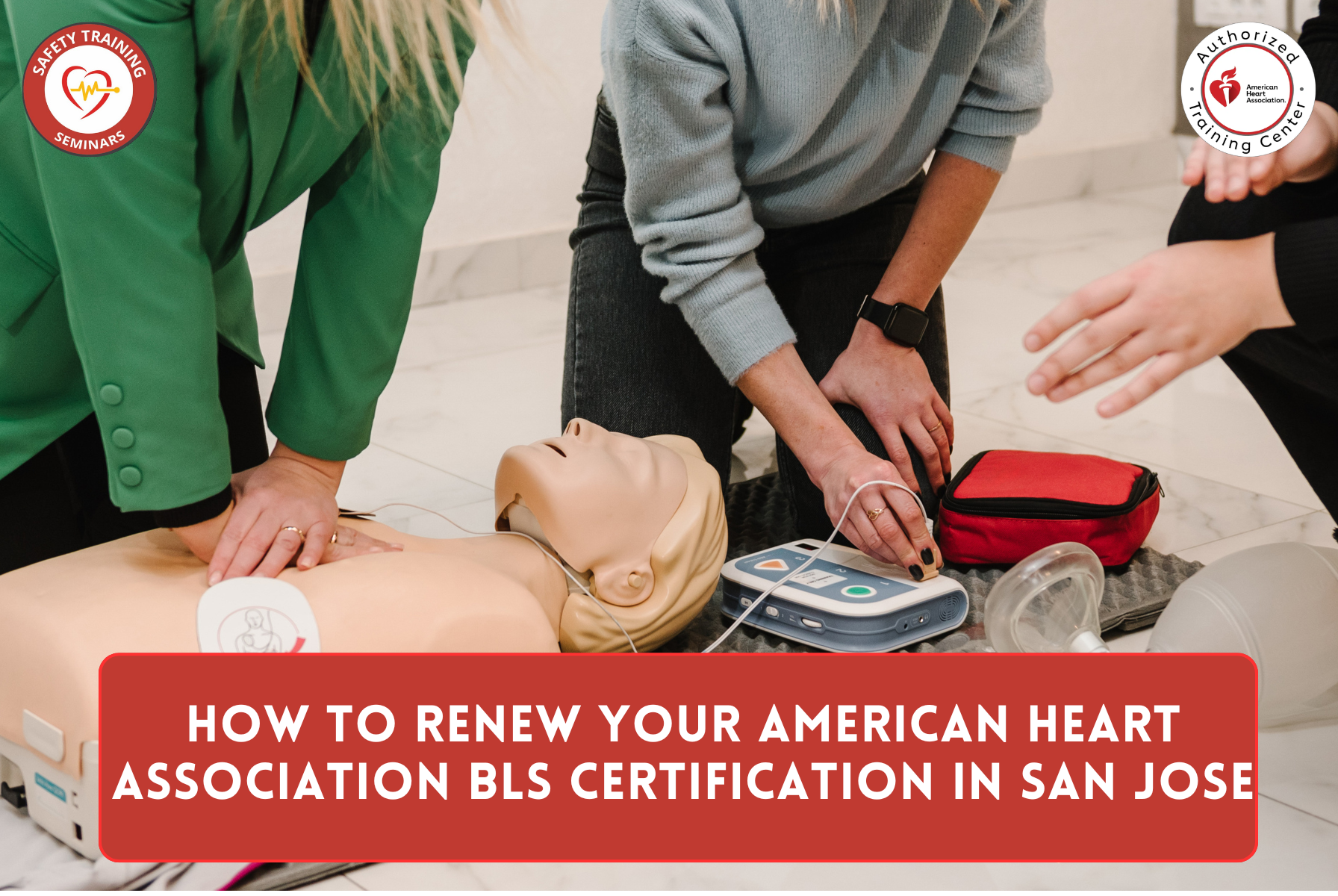
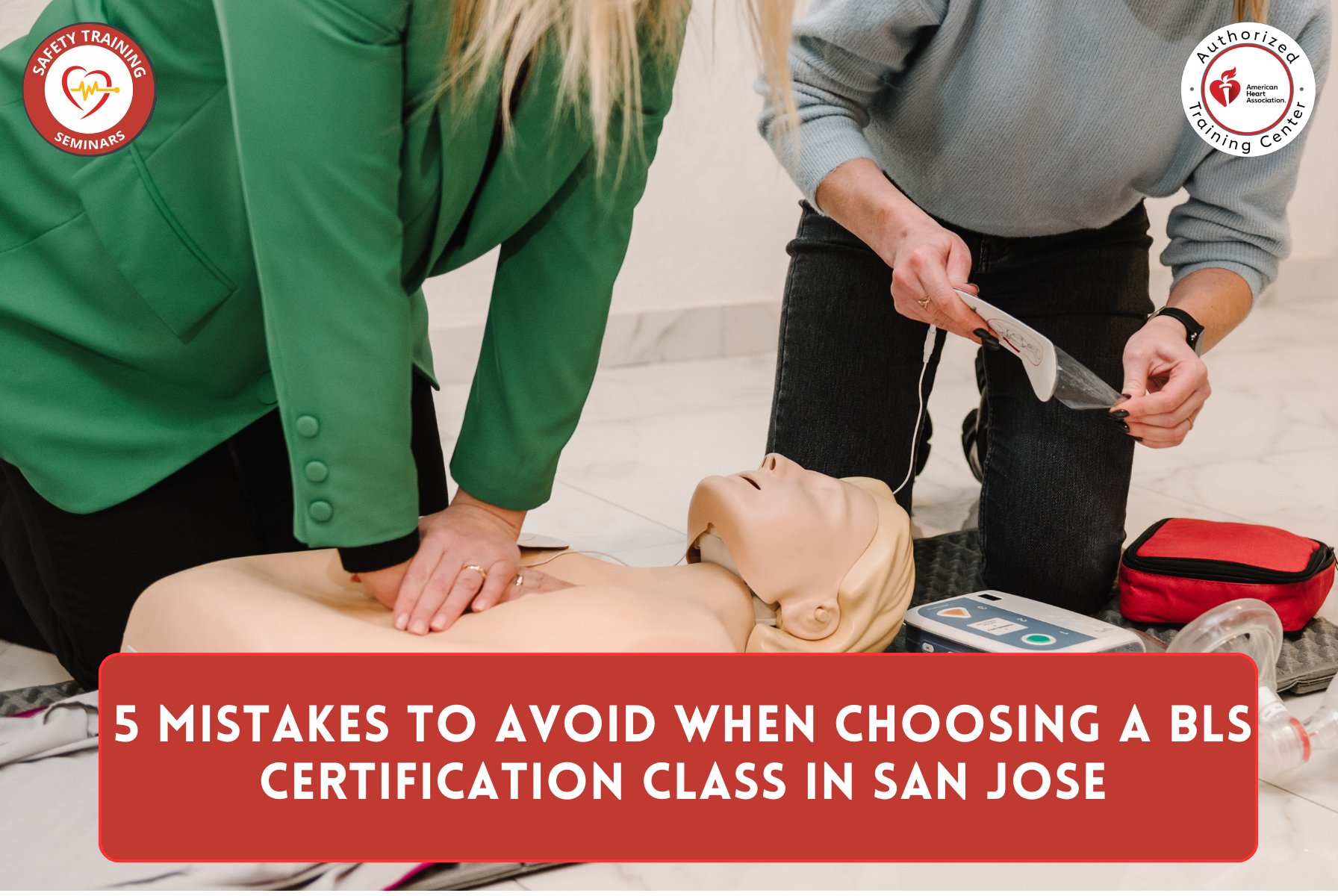
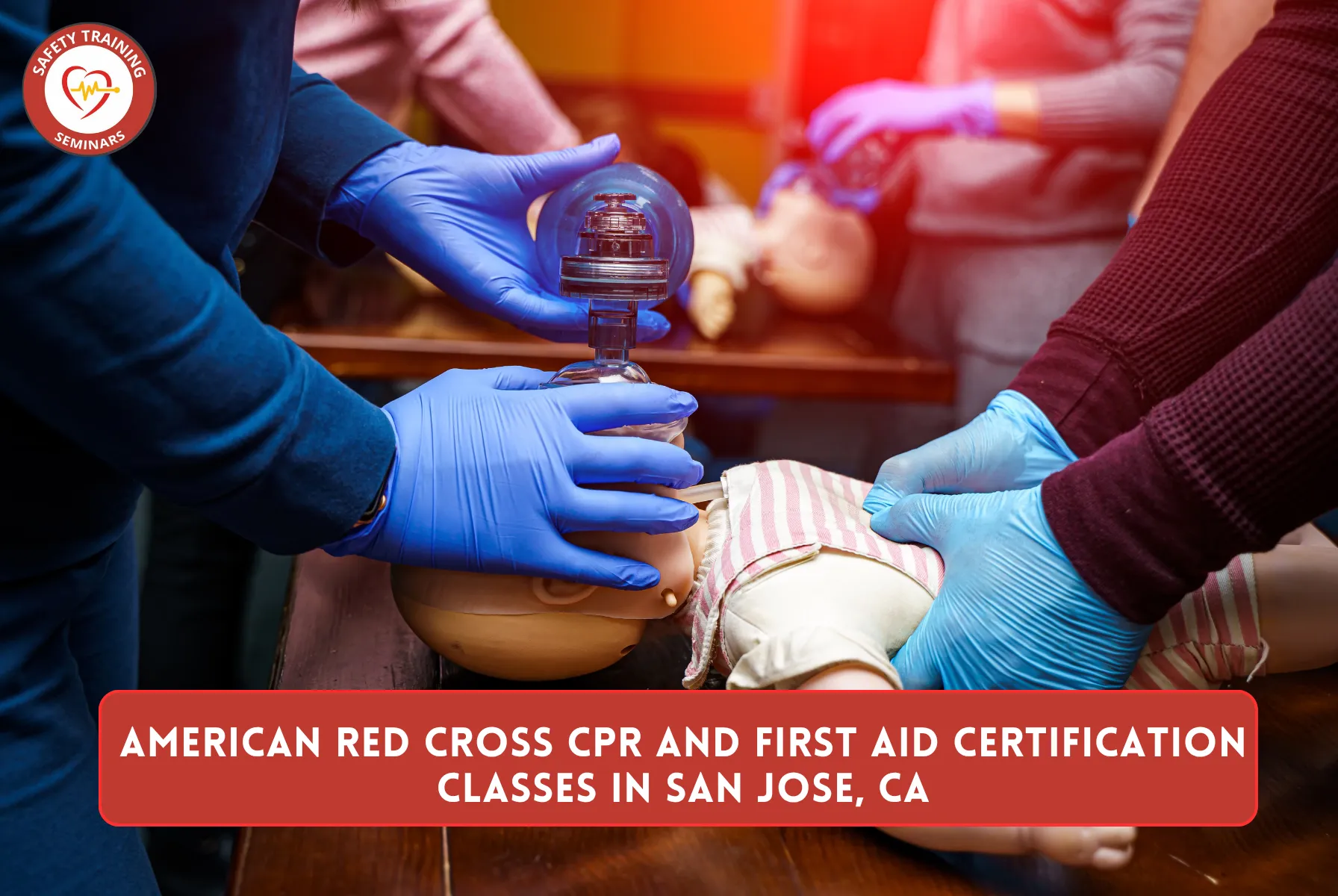
Applicable courses explain how CPR techniques differ based on the victim’s age and size. Participants practice hand placement, chest compressions, breaths, and safe response steps using training manikins.
AED operation
Students practice turning on an AED, following its prompts, attaching pads, clearing the victim, and coordinating defibrillation with ongoing CPR.
Choking response
Training may cover how to assist conscious and unconscious adults, children, and infants who have a blocked airway.
Team CPR
BLS students may practice working as part of a response team. This is valuable for school nurses, medical personnel, and staff members who may respond with other trained employees.
First Aid skills
A CPR & First Aid Course in San Jose, CA may also address bleeding, shock, burns, injuries, allergic reactions, and other common emergencies. Course coverage varies, so participants should review the selected program before registering.
Skills testing and certification
Students demonstrate required skills and complete the applicable assessment. After successful completion, eligible participants receive the corresponding certification card. The San Jose center states that same-day American Heart Association eCards are available after course completion.
Who Else Should Consider Certification?
Although this topic focuses on educators and caregivers, CPR training supports many roles across San Jose.
- Nurses and nursing students: Often need BLS for employment, clinical rotations, or program admission.
- EMTs and medical assistants: Require reliable CPR skills because they may assist during patient emergencies.
- Dentists and dental hygienists: Work in clinical settings where a patient may experience a medical event.
- Pharmacists: Frequently interact with patients and may serve as accessible healthcare professionals in the community.
- Respiratory therapists: Need strong airway and resuscitation skills.
- Personal trainers: Supervise clients during strenuous physical activity.
- Security staff: May reach an emergency before medical professionals.
- Camp counselors and youth volunteers: Supervise children in changing indoor and outdoor environments.
Healthcare workers who need higher-level credentials can review local AHA ACLS certification classes or AHA PALS certification training. ACLS and PALS are advanced courses intended for appropriate healthcare professionals, not substitutes for a general CPR and First Aid class.
Convenient Training for Willow Glen and Central San Jose
The training center’s Lincoln Avenue location is useful for people working or living in Willow Glen, Downtown San Jose, Campbell, Santa Clara, and nearby communities.
Downtown Willow Glen follows Lincoln Avenue between Coe Avenue and Minnesota Avenue. The district includes schools, childcare programs, small businesses, restaurants, parks, and community services, making the area familiar to local teachers and families.
Educators near Willow Glen Elementary School, Willow Glen Middle School, Willow Glen High School, or other San Jose Unified School District campuses can schedule training without traveling across the entire county. Coaches coming from fields near Bramhall Park or Lincoln Glen Park can also reach the Lincoln Avenue area through local streets.
For longer commutes, the website identifies I-280, Highway 87, Lincoln Avenue, Willow Street, and Curtner Avenue as primary access routes. It also states that free parking is available and that several VTA bus routes serve the area.
Registration Tips for Schools and Childcare Teams
Before enrolling, ask your employer which certification is required. A general CPR class, Heartsaver program, EMSA childcare course, and healthcare-provider BLS course are not automatically interchangeable.
Use this checklist:
- Confirm the required certification organization.
- Ask whether CPR and First Aid must appear together.
- Verify whether child and infant CPR are required.
- Check the renewal or expiration date of your current card.
- Select a course format accepted by your employer.
- Bring any required online completion document to the skills session.
- Use your correct name and email address for the certification card.
Students can review available CPR certification classes in San Jose and compare them with BLS or First Aid requirements before registering.
Frequently Asked Questions
Do teachers need BLS certification?
Most teachers do not automatically need healthcare-provider BLS unless their employer or job duties require it. Many educators take a CPR, AED, and First Aid course instead. School nurses and clinical personnel are more likely to need BLS.
Which course is best for a childcare provider?
Childcare providers should choose a course that meets their employer and California licensing requirements. This may include pediatric CPR, infant CPR, First Aid, and an EMSA-approved program.
Is CPR training useful for sports coaches?
Yes. Coaches supervise participants during physical activity and may be among the first people to respond to a collapse, breathing emergency, choking incident, or serious injury.
Will I practice infant and child CPR?
Courses designed for educators, parents, and childcare staff commonly cover child and infant CPR, but content depends on the program. Check the course description before registering.
How long does an American Heart Association certification remain valid?
American Heart Association BLS and many related course completion cards are generally valid for two years. Employers may require renewal before the listed expiration date.
Can I receive my certification card on the day of class?
The San Jose training center states that students can receive their American Heart Association eCard on the same day after successfully completing the course requirements.
Are weekend classes available in San Jose?
Yes. The website lists daily classes, including Saturday and Sunday options, which can help teachers and coaches avoid conflicts with weekday work schedules.
Prepare Before an Emergency Happens
A well-chosen CPR and First-aid Certification Course gives teachers, coaches, and childcare providers a practical response plan when a child, coworker, parent, or visitor needs immediate help.
Safety Training Seminars provides local CPR, BLS, ACLS, PALS, NRP, and First Aid course options at 1261 Lincoln Ave, Ste 213, San Jose, CA 95125. With daily scheduling, weekend availability, free parking, online registration, and same-day certification cards for successfully completed courses, the Willow Glen location offers a practical option for busy education and childcare professionals.
Review the San Jose CPR training schedule and available certification courses to select the program that matches your school, childcare license, coaching role, or employer requirements.